Pain can be exhausting at the end of a long day. Whether it comes from an old sports injury, carpal tunnel, or arthritis, you may find that conventional solutions are frustrating. Typically, you are given two options: using medication to mask pain or considering invasive surgery.
However, over the last several years, a third option has emerged from the realm of alternative medicine onto the mainstream stage of physical therapy and chiropractic: Cold Laser Therapy.
It sounds like science fiction, but the biological mechanics are not. If you are seeking a natural, medication-free method for anti-inflammatory and healing support, this Cold Laser Therapy (CLT) article is perfect for your needs!
What is Cold Laser Therapy?
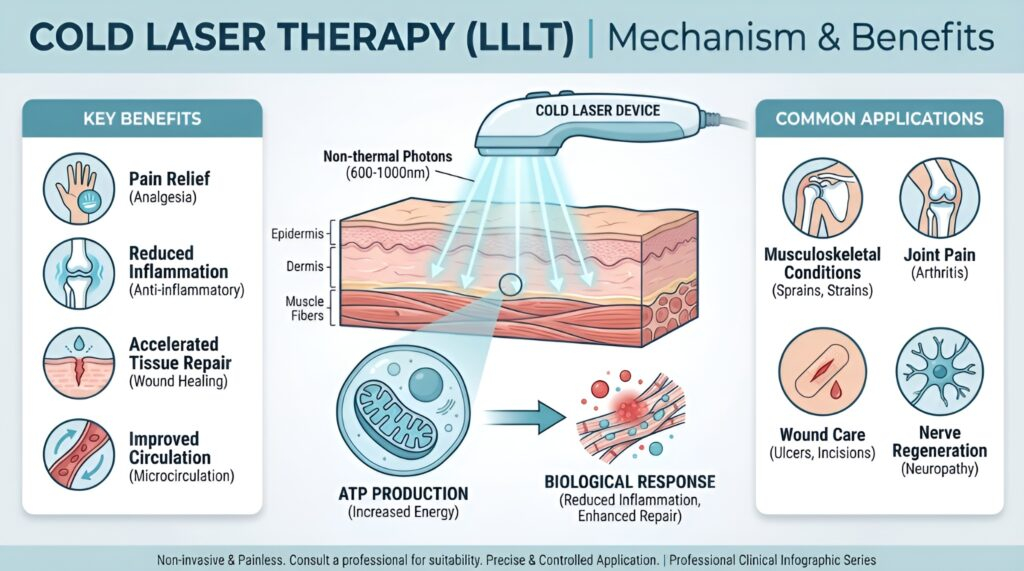
Cold Laser Therapy, also called Low-Level Laser Therapy (LLLT) or Photo-biomodulation, is a medical treatment that uses low-level light to stimulate natural healing in the body.
The term “cold” laser distinguishes it from “hot” surgical lasers. Laser surgery devices are used to cut, burn, or vaporize tissue (for instance, in laser scans for eye surgery or tumour excision). Except that cold lasers do not generate heat. They are non-thermal. The wand never feels like it is burning your skin or even warming it.
Unlike other lasers that destroy tissue, cold laser therapy aims to help it. It does this using various forms of light — typically red and near-infrared wavelengths that can penetrate the skin and affect cells beneath it.
The Science: How Does Light Heal?
To understand how it all works, you must zoom down to the cellular level. The most appropriate comparative analogy for cold laser therapy is the way in which plants use light to convert water and carbon dioxide into food.
Plants grow from sunlight. The cells in your body do, too, although they play with red and near-infrared light rather than sunshine (typically between 600nm and 1000nm).
Here is the step-by-step biological process:
Penetration: The laser source contacts the skin. Photons of light pass through the skin and are absorbed by injured tissue (muscle, tendons, or nerves).
Absorption: The light is absorbed by the mitochondria and other things in your cells. From high school biology, you might recall that mitochondria are the “powerhouse of the cell.”
ATP Production: This uptake stimulates mitochondria to generate more ATP (Adenosine Triphosphate). ATP is the fuel your cells use to function and repair themselves.
The Result: With more energy, cells can work faster and more effectively to repair tissue, reduce inflammation, and send pain signals more slowly.
In a way, the laser jump-starts your body’s own mechanism for healing itself.
What Conditions Does Cold Laser Therapy Treat?
One reason CLT has become so popular in sports medicine and chiropractic clinics is its flexibility. It is not just for back pain. It can be used for a variety of soft-tissue and joint disorders.
1. Musculoskeletal Pain
This is the most common use case. It is highly effective for:
Lower Back Pain: Minimizes inflammation in the lumbar area.
Neck Pain: Helpful for whiplash or chronic stiffness (text neck).
Knee Pain: Best used for runner’s knee and ligament strains.
2. Arthritis (Osteoarthritis and Rheumatoid)
A laser cannot “heal” cartilage that is no longer present, but it is an effective therapy for addressing arthritis symptoms. It helps counteract inflammation in the joint capsule, promotes blood flow, alleviates stiffness, and improves mobility.
3. Tendonitis and Repetitive Strain
Injuries caused by overuse respond well to LLLT because they are often characterized by chronic inflammation.
- Tennis Elbow / Golfer’s Elbow
- Carpal Tunnel Syndrome
- Achilles Tendonitis
- Plantar Fasciitis: Many podiatrists use cold lasers to relieve the sharp heel pain associated with this condition.
4. Skin Rejuvenation and Wound Healing
Dermatologists use variations of cold laser therapy to treat:
- Acne scars
- Burn scars
- Psoriasis and Vitiligo
- Diabetic ulcers (slow-healing wounds)
The Procedure: What to Expect During a Session
If you have never had a session, the unknown can be intimidating. Here is precisely what happens during an appointment.
The Setup
You will be seated or reclined in a comfortable position. Laser light is very bright, so you (and the therapist) usually wear rather thick plastic glasses or goggles to prevent straining or damaging your eyes; much the same as if you were in a tanning bed, having hair removed by a laser, and so on.
The Application
The claim is that when the therapist places a handheld device, usually roughly the size of a flashlight or showerhead — either directly against your skin or an inch above it near the painful area — you will experience sensation.
The Sensation
You will likely feel… nothing.
Some people feel a slight warmth, but it is usually because the device’s barrel does not come into contact with your skin. It is not encountering your face due to the above skin target. It is an easy, quiet process.
The Duration
Sessions are surprisingly short. Length of treatment: Treatments can range from 2 to 20 minutes, depending on the area being treated and the laser’s power output (Class III vs. Class IV).
Does Cold Laser Therapy Actually Work? (The Evidence)
This is the most critical question. Is it a placebo, or is it effective?
The conventional medical community was suspicious of LLLT for many years. However, the body of evidence has grown significantly. There are now over 4,000 studies on photo-biomodulation.
The FDA: The use of cold laser therapy has been cleared by the FDA for carpal tunnel syndrome, neck pain, and iliotibial band syndrome, among other conditions.
Clinical Studies: A 2013 systematic review found that LLLT was effective in reducing pain intensity in patients with chronic neck pain. Another study published in The Lancet showed that LLLT was more effective than a placebo for acute neck pain.
The Caveat: Cold laser treatment is seldom the “one-shot” miracle. It is cumulative. The same way you do not lose weight after a single gym visit, you typically do not get all the relief you want after a single session. A series of treatments (usually 6–30) is needed to achieve lasting results.
Class III vs. Class IV Lasers: What is the Difference?
When researching this, you will see references to “Laser Classes.” This refers to the power output.
Class IIIb (Low Level): These are the old-fashioned “cold lasers.” They are well-suited for surface trauma and for smaller joints (fingers, wrists). However, they could also deliver light more slowly, giving deeper tissues time to receive their own dose.
Class IV (High Power): These are newer, more powerful (more than 500 milliwatts). A They can propagate further into the body, including the spine, hip joints, and deep muscle tissue, much more efficiently. Class IV lasers are gaining popularity in many modern clinics due to substantially shorter treatment times.
The Pros and Cons of Cold Laser Therapy
To make an informed decision, you need to weigh the benefits against the drawbacks.
The Benefits
Non-Invasive: No needles, no incisions, no downtime.
Non-Toxic: It can cut down on NSAIDs (ibuprofen) and opioids, which have systemic side effects on the liver and stomach.
No Side Effects: There are no morning impressions or upset stomach that you get with some medications when used correctly; there is nothing but relief from LLLT.
Versatile: It can be used alongside physical therapy, chiropractic adjustments, and massage.
The Drawbacks
Cost: Obtaining insurance coverage is the most significant barrier.
Time Commitment: Attend at least 4 to 5 sessions.
Not a Cure-All: It treats the tissue, but let’s say your pain is due to a mechanical problem (such as a bone spur or when part of an extremely herniated disc is pushing on a nerve), the laser treatment can reduce inflammation associated with that dysfunction, but it would not physically take out the blockage.
Variability: Sometimes results depend on the machine and the examiner’s expertise.
Risks and Contraindications
Cold Laser Therapy is extremely safe, but there are a few scenarios in which cold laser therapy should not be used:
Eyes: In case of eye contact, may cause retinal injury. Goggles are non-negotiable.
Cancer: Lasers stimulate cell growth. For that reason, they should never be applied over a known cancerous lesion or tumour, since there is a theoretical risk of promoting the growth of cancer cells.
Pregnancy: Doctors would rather not use a laser directly over the pregnant abdomen, as a precaution.
Thyroid: Do not apply directly to the thyroid gland unless advised by a professional, as it may alter hormone production.
Cost of Cold Laser Therapy
This is often the deciding factor for patients.
Insurance Coverage
Many large medical insurers (and Medicare) consider Cold Laser Therapy “investigational” or “experimental” and will not cover it. However, this is changing slowly. Some plans may cover it if it is part of a physical therapy visit, but assume you will pay out of pocket.
Out-of-Pocket Costs
Price varies significantly across geographic areas and the type of laser used.
Per Session: Average cost ranges from $30 to about $150.
Packages: Many clinics offer packages (10 sessions for $400, say), which reduce the per-visit price.
If you are prescribed a rigorous schedule (three times per week for a month), costs can add up; therefore, talk with your provider about finances in advance.
Can You Do Cold Laser Therapy at Home?
A quick Amazon search will reveal dozens of “Cold Laser” devices for home use, ranging from $100 to $2,000. Do they work?
The Reality of Home Devices. Most home devices use LEDs (Light-Emitting Diodes) or very low-power lasers.
LED vs. Laser: For most home devices that have FDA clearance, the company says it uses LEDs (Light-Emitting Diodes) or very low-power lasers. They are not as deep as a clinical laser.
Power Output: A clinical Class IV laser may deliver 10 watts of power. An in-home device could emit 50 milliwatts. For the same dose of energy from a home machine that you get in 5 minutes in a clinic, it might need to sit on your skin for 2 hours.
Verdict: Home devices can be helpful for some superficial issues, such as mild finger arthritis and skin issues, but not for deep back pain/sciatica, as they generally do not have the power to reach the injury site.
How to Choose a Provider
If you decide to try Cold Laser Therapy, do not just walk into the first clinic you come across.
Ask About the Device: What type of laser do they use? If you have an injury deep in a joint (shoulder, hip, back), you want at least a Class IV laser.
Ask About Experience: How long have they been practicing this therapy?
Look for Integrated Care: The most effective results seem to occur when the laser is combined with other treatments. A laser may be able to relieve pain enough that you can do the exercises, she said — and it is the physical therapy that fixes the mechanical problem.
Conclusion: Is It Right For You?
Cold Laser Therapy is the middle ground between doing nothing and having surgery. For athletes, it means a quicker return to the field. It provides a break for those with low-level chronic pain without the brain fog of, say, over-the-counter painkillers.
Although it will take some time and patience, and you will have to give up a portion of your day (or night), the science behind photo-biomodulation is there. By providing cells with the energy they need to repair themselves, you help your body heal naturally.
Cold Laser Therapy may be considered if you have a lingering injury that has not resolved with rest and ice.
Frequently Asked Questions (FAQs)
How quickly will I see results?
Some patients feel relief immediately after the first session due to reduced inflammation. However, for most chronic conditions, noticeable lasting improvement is usually observed after 3 to 5 sessions.
Is Cold Laser Therapy permanent?
The tissue heals better with the laser. Pain relief can be permanent if the tissue heals back. But for chronic complaints like arthritis, the laser functions as a management tool — periodic “maintenance” treatments could be offered to hold pain at bay.
Does it hurt?
No. It is a completely painless, non-thermal procedure.
Can I combine it with other treatments?
Yes. In fact, it is recommended. It works great in conjunction with physical therapy, chiropractic, acupuncture, or massage.
Is it the same as Infrared Saunas?
No. Both use light therapy, but where tanning salons beam rays onto small patches of skin, infrared saunas aim for a full-body sweat and flush. Cold laser therapy uses concentrated beams of light directed at the injury site to promote cell repair.