
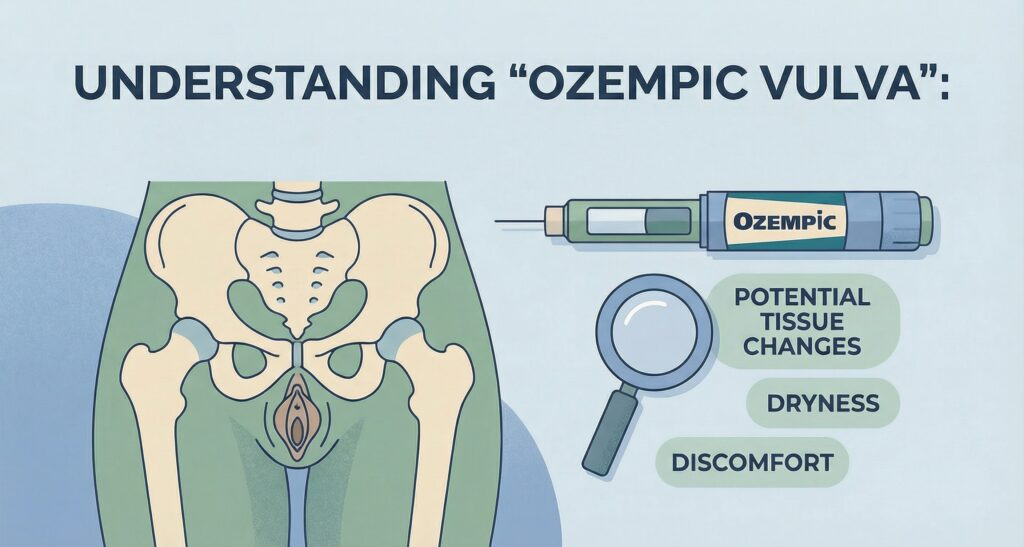
The acceptance of GLP-1 receptor agonist treatment, particularly Semaglutide (Ozempic for type 2 diabetes and Wegovy for weight control), is a milestone in metabolic medicine. However, both these drugs also run with the aspect of empires; there are also such strange and unpleasant unwanted side effects in women’s vulvovaginal area, known as Ozempic vulva, which females get while working off this drug from their body, as some aftertaste. This issue, highlighted by social media, warrants a scientifically robust investigation.
Ozempic vulva is not an official medical diagnosis, but more of a slang term that has developed to refer to any vaginal and vulvar changes that you may experience while on GLP-1 agonists. Despite the title, which explicitly mentions Ozempic, these changes can occur with any GLP-1 receptor agonist, including other forms of Semaglutide (Wegovy and Rybelsus) and related drugs.
The pathological changes range from a wide variety of anatomical and functional defects. Typical cases state that changes include Vulvar skin sagging and smoothing or deflation of the labia majora in addition to an overall loss of vulva fullness. Functional symptoms may manifest as vaginal dryness, sensation of vaginal laxity, loss of sexual sensation, and incontinence secondary to potential pelvic floor weakness.
These alterations may be more likely due to rapid weight loss, possibly triggered by these pharmacological agents, rather than to a direct effect of these agents on the vulvovaginal tissues.
Understanding GLP-1 Receptor Agonists
Pharmacological Action
GLP-1 receptor agonists act in a similar way to the body’s own incretin hormone GLP-1, which controls blood sugar levels and appetite. According to a 2022 systematic review published in Frontiers in Pharmacology, this study aims to systematically review the weight-loss effects and safety (including adverse events, withdrawals due to side effects/deaths) of Semaglutide as a traditional anti-obesity treatment for non-diabetic obese/overweight individuals.
Reproductive Tissue Distribution
Body Composition Changes: The Evidence Base
Weight Loss and Fat Mass Reduction
The STEP 1 trial, published in the New England Journal of Medicine in 2021, demonstrated substantial weight loss with semaglutide therapy. In this double-blind trial, we enrolled 1961 adults with a body-mass index (the weight in kilograms divided by the square of the height in meters) of 30 or greater (≥27 in persons with ≥1 weight-related coexisting condition), who did not have diabetes, and randomly assigned them, in a 2:1 ratio, to 68 weeks of treatment with once-weekly subcutaneous Semaglutide (at a dose of 2.4 mg) or placebo, plus lifestyle intervention. The primary endpoints were the percentage change in body weight and weight reduction of at least 5%. The mean change in body weight from baseline to week 68 was -14.9% in the semaglutide group as compared with -2.4% with placebo, for an estimated treatment difference of -12.4 percentage points.
Lean Mass Preservation Concerns
A critical consideration in understanding vulvovaginal changes is the impact on lean mass. According to a 2024 systematic review published in Expert Opinion on Pharmacotherapy, Semaglutide, a glucagon-like peptide-1 receptor agonist, is associated with significant weight loss. Yet, its impact on lean body mass remains insufficiently understood. This review investigates the effect of Semaglutide on lean mass in the context of obesity management. Six studies with 1,541 overweight or obese adults were included, and significant weight reductions were observed primarily due to fat mass loss. While lean mass remained stable in some cases, notable reductions of 0%-40% of total weight were observed in others.
A 2023 study published in Clinical Medicine Insights: Endocrinology and Diabetes evaluated changes in body composition among Chinese adults. The researchers found that A total of 53 obese patients received 24 weeks of lifestyle intervention plus semaglutide treatment. 10 patients who failed to attend follow-up were excluded, leaving 43 patients for the study. The average baseline body mass index (BMI) was 33.0 kg/m2, and the average body weight was 90.0 kg. After 6 months of treatment, the patient’s weight decreased by 9.9 ± 3.9 kg (p < 0.001), and the weight-loss percentage was 11.2 ± 4.5% (p < 0.001). Body composition analysis showed that the loss of skeletal muscle mass was 1.4 ± 1.3 kg (p < 0.001), which was significantly less than the loss of fat mass of 5.6 ± 3.7 kg (p < 0.001).
Pathophysiological Mechanisms
Primary Mechanism
The fundamental mechanism appears to be related to the rapidity and magnitude of weight loss rather than direct drug effects on vulvovaginal tissues. When rapid weight loss occurs, the fat pads that provide volume to the mons pubis and labia majora can shrink significantly. If skin elasticity and connective tissue adaptation cannot keep pace with volume loss, the result is a looser, less-supported appearance of the vulvar structures.
Secondary Mechanisms
Hormonal Alterations
Remarkably rapid weight loss can significantly affect hormone levels. Adipose tissue serves as a site for peripheral estrogen production through aromatization of androgens. Fast fat loss may lead to decreased estrogen levels, which are essential for maintaining vaginal tissue health, elasticity, and lubrication.
Dehydration and Gastrointestinal Effects
According to clinical trial data from the STEP studies, however, despite undeniable benefits, treatment with Semaglutide induced adverse effects, among which gastrointestinal disorders were the most frequently reported. This study aims to investigate the treatment effects, benefits, and drawbacks of Semaglutide in overweight or obese adult (18+) patients with type 2 diabetes. Gastrointestinal side effects, including nausea, diarrhea, and vomiting, can lead to dehydration, potentially exacerbating vaginal dryness.
Muscle Mass Changes and Pelvic Floor Impact
One 2021 review published in Current Diabetes Reviews examined the effects of GLP-1 agonists on muscle mass and body weight in patients with type 2 diabetes. Across the board, individuals taking Semaglutide had a significantly greater decrease in fat-free mass (a.k.a. muscle mass) than those taking a placebo. This muscle loss can extend to the pelvic floor muscles, which support the reproductive and excretory organs. Weakening of these muscles may lead to symptoms including urinary incontinence, pelvic organ prolapse, or changes in sexual function.
Clinical Research Evidence
Body Composition Studies in Real-World Settings
A 2023 prospective real-life study published in Frontiers in Endocrinology examined the effects of oral Semaglutide on body composition. Thirty-two patients with T2D were evaluated at baseline (T0) and after three (T3) and six (T6) months of therapy with oral Semaglutide. At each time point, body composition was assessed using a phase-sensitive bioimpedance analyzer. Clinical, anthropometric, and laboratory parameters, as well as the primary biometric surrogates of liver steatosis and fibrosis, were also analyzed and compared. A significant and early reduction in anthropometric and glucometabolic parameters, alanine aminotransferase, Fatty Liver Index, and Fat Mass was observed.
Gender-Specific Considerations
A 2025 study in Medicina examined the effectiveness of Semaglutide in postmenopausal women. The research found that Menopause is a complex period in women’s lives, when weight gain and predisposition to obesity are frequent. Moreover, even during menopause transition, women begin to lose lean mass up to 0.5% and, therefore, an increase in the percentage of fat mass with central distribution and an increased risk of metabolic syndrome. After 4 months of Semaglutide 1 mg, either weight loss (5.9 ± 5.2 vs. 4.5 ± 3.5 kg; P = 0.1) or percentage of weight loss (5.8 ± 4.7% vs. 5.1 ± 3.2%; P = 0.4) was comparable. Despite greater initial weight and fat mass in postmenopausal women, after 4 months of Semaglutide 1 mg treatment, either fat mass loss or weight loss was similar to that observed in premenopausal women.
Impact on Reproductive Function
According to a 2025 review in Acta Obstetricia et Gynecologica Scandinavica, the molecular changes in the endometrium induced by weight loss remain a substantial gap in our current knowledge. Consequently, there is a compelling need for research focused on these patient groups to elucidate how weight loss, facilitated by GLP-1RA-mediated metabolic regulation, influences reproductive success. Novel strategies are needed to more deeply examine the impact of GLP-1RAs on endometrial receptivity and embryo implantation.
Comparative Analysis with Other Weight Loss Methods
A 2024 study published in Frontiers in Endocrinology comparing oral and subcutaneous Semaglutide found that Participants (n=88) experienced significant weight loss after treatment with Semaglutide (9.5% in subcutaneous, 9.4% in oral, P<0.001). Weight reduction primarily resulted from reduced fat mass, without substantial compromise of lean mass. Visceral fat area decreased, while phase-angle remained stable. Improvements in lipid profiles and glycaemic control were observed, with a decrease in both HbA1c and insulin requirements.
It should be remembered that vulvovaginal changes are not specific to treatment with GLP-1 receptor agonists. Rapid and substantial weight loss by any means is a risk; this can include not only bariatric surgery but dieting itself or other medications. What makes the difference is how quickly and in what amounts weight comes off; the more rapid and larger the losses, the more those changes get noticed compared to slow-moving fat loss that gives physiques more time to acclimatize.
Management Strategies
Hydration and Local Care
Hydration is key here, especially for patients with nausea as a dosing side effect. The use of moisturizers and lubricants for the vagina can help relieve dryness. Postmenopausal women may benefit from local estrogen if indicated.
Pelvic Floor Rehabilitation
Popular specialized physical therapy is vital for preventing pelvic floor muscle weakness. Pelvic floor exercises (such as Kegel exercises) can also help keep the muscles in your pelvis strong and functioning, which may reduce or reverse symptoms of pelvic floor dysfunction.
Optimizing Weight Loss Rate
Reducing the rate of weight loss to a slightly more modest rate and supplementing with resistance training could preserve tissue and muscle, thereby decreasing vulvovaginal changes.
Advanced Interventions
For women experiencing significant distress or functional impairment, several interventional options exist:
- Radiofrequency treatments: These will promote collagen and elastin production within vulvovaginal tissues.
- Surgical options: Popular cosmetic genital procedures, such as labiaplasty for cosmetic reasons or tightening the vagina for functional purposes.
- Fat grafting: The application of the patient’s own adipose tissue as a filler to volumize the labia majora can be an effective strategy as well.
Special Populations and Considerations
Postmenopausal Women
According to research published in Menopause in 2024, in postmenopausal women with overweight or obesity treated with Semaglutide, hormone therapy use was associated with an improved weight loss response. This association remained after confounding adjustment. HT was found to be a predictor of a more beneficial weight loss response in postmenopausal women with overweight or obesity receiving Semaglutide. This association persisted after adjustment for confounders.
Hormonal therapy (HT) use has not only been linked to reduced loss of lean mass but also to an increase in lean mass of 1%, thereby supporting the notion that HT might exert protective effects on some vulvovaginal features associated with GLP-1 receptor agonist therapies.
Women with Polycystic Ovary Syndrome (PCOS)
A 2022 review in Therapeutic Advances in Reproductive Health noted that GLP-1R agonists have achieved remarkable weight loss and reductions in abdominal fat in patients with type 2 diabetes (T2D), as well as in overweight/obese individuals and individuals with prediabetes. These beneficial effects have been suggested to be particularly helpful in women with PCOS, while their possible role in the hypothalamic-pituitary-gonadal axis is under intense research.
Future Research Directions
Endometrial and Reproductive Health
The influence of GLP-1RAs on reproductive health is not limited just to vulvovaginal modification. The molecular alterations localized to the endometrium after weight loss are a significant unknown. Consequently, there is a compelling need for research focused on these patient groups to elucidate how weight loss, facilitated by GLP-1RA-mediated metabolic regulation, influences reproductive success. It is necessary to use novel technologies to explore further the influence of GLP-1RAs on endometrial receptivity and embryo implantation.
Male Reproductive Considerations
According to a 2024 review in Medicina, GLP-1 receptors have been identified in the male reproductive system in the existing literature. Although the precise pathways are unclear, they may be involved in glucose homeostasis and energy metabolism, which are critical for spermatogenesis. Many clinical trials have shown the efficacy of GLP-1 RAs in weight loss. Studies indicate that GLP-1 RAs treatment in obese males may increase sperm metabolism and motility, as well as improve sperm in vitro insulin secretion and human Sertoli cell function. Recent trials reviewed in this article show that GLP-1 RAs-related weight loss is associated with a beneficial effect on sperm parameters (sperm count, concentration, and motility).
Long-term Muscle Preservation Strategies
According to research published in Diabetes, Obesity and Metabolism in 2025, after 3 months, average weight loss was 4.11 (2.77) kg or 4.57% (2.96%). Individuals lost fat mass (2.67 (2.37) kg) and trunk fat mass (1.10 (1.36) kg), while also losing small amounts of lean mass (1.43 (1.41) kg) and skeletal muscle mass. In addition, body composition improved, with reductions in fat mass and increases in the overall proportion of lean and skeletal muscle.
Clinical Implications and Patient Counseling
Pre-Treatment Assessment
Healthcare professionals should undertake a thorough examination before starting GLP-1 receptor agonist therapy. This includes assessment of baseline pelvic floor function, counseling on prospective vulvovaginal changes, and identification of patients at increased risk of such effects (menopausal status, any significant history of pre-existing pelvic floor dysfunction).
Monitoring and Follow-up
Routine measurements should be made of changes in body composition, focusing on the proportions of fat and lean mass loss. According to a 2024 study in Frontiers in Endocrinology, we observed that weight loss was primarily due to a reduction in fat mass (FM) rather than free-fat mass (FFM), suggesting a decrease in free mass without significant loss of lean mass.
There has been ongoing discourse in the literature regarding a potential association between Semaglutide use and the onset of sarcopenia. However, most studies indicate that Semaglutide primarily induces weight loss by reducing fat mass while either preserving muscle mass or even enhancing the relative proportion of skeletal muscle, with minimal or non-clinically relevant impact on muscle strength.
Addressing Social Media Influence
A 2024 study published in Naunyn-Schmiedeberg’s Archives of Pharmacology examined social media representation of Semaglutide. The research found that Semaglutide was almost exclusively promoted on social media for weight reduction. Misrepresentation of the pharmacological properties of Semaglutide with respect to the mechanism of action, indication, adverse effects, and drug interactions was widespread on social media.
Most content creators on Instagram and TikTok were female semaglutide users without medical knowledge. Strikingly, the widespread gastrointestinal problems during semaglutide therapy were not even mentioned on Instagram.
Conclusion
Ozempic vulva is a spectrum of complex vulvovaginal changes observed following treatment with GLP-1 receptor agonists, less related to the drug’s direct pharmacologic effect and more the consequence of rapid weight reduction. Although such alterations can be distressing for affected women, knowing their etiology and managing them effectively can lead to the best outcomes.
The findings of several clinical trials, with the latest being Stepping (STEP) studies as reported in the New England Journal of Medicine, have shown that GLP-1 receptor agonists are associated with massive weight loss attended by changes in body composition, such as reduction of fat and lean mass, which may result in vulvovaginal complaints. The patterns associated with this medication appear to be the same as for other rapid weight-loss treatments, in which there is a rate and extent of weight-loss effect rather than an entertaining away from treatment.
Standard evaluation methods should be established for vulvovaginal changes in these tracts in future studies, and preventive modalities could be investigated in a prospective study with accurate incidence data. Furthermore, new strategies to prevent loss of muscle mass and/or tissue function during weight loss, and the underlying mechanisms thereof, should be explored to maximize therapeutic benefit.
Given the increasing use of GLP-1 receptor agonists in patients, clinicians must have this discussion with their patients and reassure them that, although such acceptable side effects are associated with very significant metabolic benefits. With further evidence, full-spectrum care, and patient information, our collaboration will become more effective in attaining metabolic success and robust vulval vaginal health.

